Customized Production Lines for Non-Standard Zipper Widths, Tapes, and Color Matching
1. Introduction: When Standard Zippers Just Won't Cut It
Let me start with something I've run into more times than I can count. You're deep into product development – maybe it's a luxury handbag, maybe it's a technical outdoor jacket, maybe it's a piece of furniture – and you realize the standard zipper off the shelf just isn't going to work. The width is wrong. The tape color doesn't match. The material feels cheap against the fabric you've spent months sourcing.
And suddenly, you're not just buying a zipper. You're customizing a production line for non-standard zipper widths, tapes, and color matching.
I've been working in textile and hardware sourcing for about twelve years now, and if there's one thing I've learned, it's that custom zipper production is a different beast entirely from standard procurement. The lead times are longer. The minimums are higher. The quality control is more demanding. But when you get it right, the result is a zipper that perfectly complements your product – and that's the difference between "good enough" and "exceptional."
The global zipper market has been evolving rapidly. Manufacturers are no longer just pushing out standard black, white, and navy zippers in a handful of sizes. They're offering customized production lines that can handle everything from non-standard widths to custom tape materials to exacting color matches.
Here's the question that comes up constantly: what does it actually take to get a non-standard zipper produced? How do you specify it? How long does it take? What are the minimums?
I want to walk you through the practical realities of custom zipper production. Not a glossy brochure – a genuine, hands-on discussion of what works, what doesn't, and why it matters.
2. Why Non-Standard Zipper Customization Matters
Here's the thing about zippers that a lot of people underestimate. A zipper isn't just a fastener – it's a design element. It's a functional component. And in many products, it's a branding opportunity.
Standard zipper sizes typically range from #3 to #10, with corresponding tape widths that follow industry norms. But what happens when your product requires a #7 zipper? Or a #12? Or a tape width that falls between standard sizes? Non-standard zipper widths are where custom production comes into play.
The tape itself matters just as much. Different applications demand different tape materials – cotton for heritage denim, polyester for outdoor gear, nylon for flexibility. Some products require branded tape with woven logos or custom textures. Others need specialty treatments like flame retardancy or waterproofing.
And then there's color. Oh, color. Getting a zipper tape to match a specific fabric shade – whether it's a Pantone reference, a physical swatch, or a brand's signature color – is one of the most demanding aspects of custom zipper production.
The reality is that non-standard zipper customization has become table stakes for brands that want to differentiate themselves. Consumers notice the details. A perfectly matched zipper tells a story about quality and attention to detail. A mismatched one tells a different story entirely.
3. Custom Zipper Widths: Beyond the Standard Sizes
Let's talk about width first, because this is where a lot of the confusion starts.
Understanding Zipper Sizing
Zipper sizes are typically designated by numbers – #3, #5, #8, #10 – that indicate the approximate width of the zipper teeth in millimeters when closed. The tape width is a separate measurement, and it can vary independently of the tooth size.
Standard zipper tape widths follow industry norms, but they're not universal. Different manufacturers use different standards. And when your product requires a specific tape width – say, a wider tape for a heavy-duty bag, or a narrower tape for a delicate garment – you're entering the realm of custom production.
Non-Standard Width Options
Custom zipper widths can be produced across a range of sizes. Some manufacturers offer tape widths from 3mm to 110mm. Others specialize in specific ranges – 3mm to 12mm for lightweight applications, or wider tapes for industrial uses.
The key is that the width specification must be communicated clearly. As one manufacturer notes, tape size can be customized to be widened or narrowed. But this isn't a simple adjustment – it requires changes to the weaving setup, the slitting process, and often the production line itself.
When Width Matters
Why would you need a non-standard width? Several scenarios come to mind:
Heavy-duty applications – bags, luggage, outdoor gear – where a wider tape provides better anchorage and durability
Lightweight or delicate garments where a narrower tape reduces bulk and improves drape
Design requirements where the tape width is a deliberate aesthetic choice
Compatibility with specific hardware where standard widths don't fit
Some manufacturers specialize in these non-standard requests. Suppliers note that they can customize tape size to be widened or narrowed across various zipper types. The ability to handle these requests is what separates a flexible manufacturer from a rigid one.
4. Custom Zipper Tapes: Materials, Textures, and Branding
The tape is the foundation of the zipper. And in custom production, it's where a lot of the differentiation happens.
Tape Materials
The choice of tape material affects everything – durability, flexibility, dyeability, and cost.
Polyester tape is the modern standard. It offers excellent dimensional stability, UV resistance, and moisture resistance. Most industrial and outdoor zippers use polyester tape.
Nylon tape is softer and more flexible. It's commonly used in apparel and applications where drape matters.
Cotton tape is less common in modern zippers but still found in heritage denim and some workwear applications.
Custom production allows you to specify the material that best suits your application. Some manufacturers offer cotton, polyester, and blended options with different finishes.
Tape Textures and Designs
Beyond material, the tape itself can be customized in numerous ways. Branded tapes – with woven logos, stripes, or patterns – are increasingly popular.
YKK's PRIFA® line, for example, offers zippers with colorful inkjet prints on the tape, allowing for logos, patterns, and gradations. Designed woven tapes can feature herringbone, melange, and denim-look patterns.
Custom tape designs require specialized weaving equipment – often jacquard looms that permit control of each thread. This is not something every manufacturer can do, so it's worth confirming capabilities early.
Specialty Treatments
Some applications demand more than just a standard tape. Technical tape treatments – flame retardant, waterproof lamination, anti-static – are available but typically add 4–6 weeks to lead time.
Some manufacturers also offer specialty zippers like wide-edge zippers, multi-color tape zippers, color-tooth zippers, waterproof flame-retardant zippers, and PVC zippers. The range of options is extensive – but not every factory can produce every option.
5. Color Matching: The Art and Science of Getting It Right
Color matching is, in my experience, the single most challenging aspect of custom zipper production. And it's where things most often go wrong.
The Raw State
Before dyeing, zipper tape is produced in its natural state – typically off-white or pale cream. This is called greige tape. The coil or teeth are also produced in undyed or lightly pigmented form.
For white or cream applications, no dyeing is required. But for any other color, the tape – and sometimes the coil – must be dyed.
The Dyeing Process
Zipper tape is dyed using one of two processes:
Beam dyeing is a batch process where tape is wound onto a perforated beam and dye liquor is pumped through under controlled temperature and pressure. It offers excellent dye penetration and color consistency within a batch. The challenge? Batch-to-batch variation is a real risk – even with identical dye recipes, differences in water chemistry, vessel condition, and temperature uniformity produce color variation.
Continuous dyeing runs the tape continuously through a dye bath and fixing stage. It produces better batch consistency for high volumes. For short runs, beam dyeing is more economical.
The dye chemistry depends on the fiber type:
Polyester tape uses disperse dyes at high temperature (130°C) – vibrant colors, excellent wash fastness
Nylon tape uses acid dyes at 90–100°C – excellent color depth, good lightfastness
Cotton tape uses reactive dyes – good wash fastness, higher water consumption
Color References
Custom color matching typically uses one of several reference systems:
Pantone – the industry standard for color communication
GCC – Chinese Zipper Color Card
CCC – another Chinese color standard
YKK color cards – YKK's proprietary color system
Physical swatches – providing a sample of the fabric or color to match
Custom Pantone-matched tape color requires a minimum dye batch, typically in the hundreds of meters. Custom colors typically add 2–4 weeks to standard production lead time.
The Color Matching Process
The typical sequence for custom zipper dyeing follows a specific path:
Submit standard – physical swatch, color reference, and light source specification
Lab dip – supplier produces dyed tape samples (typically 3–5 options at different concentrations)
Approval – client selects and approves the closest match
Production – bulk dyeing based on the approved lab dip
Color sampling for custom dyeing typically takes 3–5 days for lab sample development. Bulk production then follows.
Some manufacturers maintain extensive color libraries to speed up the process. One supplier notes they have over 600 colors available, with the option to match Pantone or YKK codes. Another offers Pantone, YKK, GCC, and CCC color cards, plus sample-based color confirmation.
Color Consistency Challenges
Here's the thing about color matching that a lot of people don't realize. Even with the best processes, color consistency across production runs is never guaranteed. Batch-to-batch variation is the primary cause of color matching issues in repeat production orders.
If you're ordering the same custom color across multiple production runs, you need to plan for this. Some manufacturers offer to hold a sample of the approved color for reference. Others can provide dyeing certificates. But the best approach is to order enough for multiple seasons in a single production run, which ensures color consistency.
6. The Custom Production Line: How It All Comes Together
So how does a custom zipper actually get made? Let me walk you through the process.
Full-Service Production
Many manufacturers now offer full-service production that covers every step of the zipper manufacturing process. As one supplier describes, they provide mold-making, die-casting, dyeing, electroplating, and baking paint as a one-stop service.
The full production sequence typically includes:
Weaving – producing the tape on specialized looms
Dyeing – coloring the tape to the specified shade
Forming – creating the teeth (coil, molded, or metal)
Assembling – attaching teeth to tape, installing sliders and stops
Finishing – surface treatments, quality inspection, packaging
Equipment Requirements
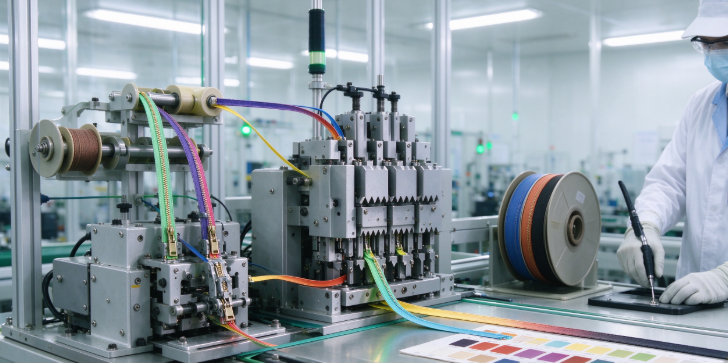
Custom production requires specialized equipment. High-speed zipper tape machines are designed for weaving tapes that match metal, nylon, and plastic zippers. Some machines can produce 2 to 12 tapes simultaneously, with widths from 3mm to 110mm.
For custom tape designs – branded tapes, jacquard patterns – manufacturers need jacquard looms that permit control of each thread of the weft, warp, and cord.
Integrated vs. Outsourced
Some manufacturers are fully integrated – they handle every step of production in-house. Others outsource certain steps, like dyeing or plating. Fully integrated manufacturers generally offer better quality control and shorter lead times, but they're also more expensive.
One manufacturer notes they have over 40 patents and 20+ core technologies, with all core technologies and machinery developed in-house. This level of integration allows for greater customization and faster problem-solving.
OEM and ODM Services
Most custom zipper manufacturers offer OEM (Original Equipment Manufacturer) and ODM (Original Design Manufacturer) services:
OEM – you specify the zipper specifications, they manufacture to your specs
ODM – they help you design innovative zipper models based on your requirements
Some manufacturers also offer private label support, allowing you to use your logo on pullers, packaging, and tape.
7. Lead Times, MOQs, and What to Expect
Let me be direct about this: custom zipper production takes time. And if you don't plan for it, it will wreck your production schedule.
Minimum Order Quantities
MOQ thresholds vary significantly by specification type:
Standard zippers in stock colors – 10 to 50 units, immediate dispatch
Custom Pantone-matched tape color – minimum dye batch, typically hundreds of meters
Custom-tooled pull tab – 500 to 2,000 pieces to amortize tooling
Bespoke construction – may require a full production batch
Some manufacturers offer more flexible MOQs. One supplier notes that standard colors can be ordered in as few as 1,000 or 500 pieces, while special colors without stock require 1,800 meters minimum.
For small-batch, fast-turnaround needs, some suppliers specialize in "small order, fast response" – sample lead times around one week.
Lead Times: The Numbers You Need
Here are the lead time benchmarks you should expect:
Specification Type | Lead Time |
Standard stock zippers | 2–5 working days |
Custom tape color (new color development) | 3–5 weeks (lab sample) + 2–4 weeks (production) |
Custom pull tab (new tooling) | 4–8 weeks |
Technical tape treatments | 4–6 weeks |
Standard production run (non-stock) | 3–5 weeks |
Total for custom color | 5–9 weeks from enquiry to delivery |
The reliable planning rule: any zipper specification that is not a standard stock item needs 6 weeks minimum in the schedule, with 8 weeks preferred.
Some manufacturers offer faster turnaround. Sample development can take 3–5 days. Bulk production might be 7–10 days for simpler custom orders. But for complex custom work – especially custom color matching – you should plan for the longer timeline.
The Mistake That Gets Made Every Season
Here's a pattern I see constantly: teams plan around fabric – the longest lead item – and treat zippers as an afterthought. But custom zipper specifications have lead times that match custom fabric.
The right approach:
For development samples: order zipper samples when you order fabric samples
For production: place the zipper production order at sample sign-off, not at production scheduling
Managing Seasonal Peaks
The accessories supply chain has seasonal peaks. If you're planning a seasonal collection, factor this in. Ordering early – and ordering enough for multiple seasons in a single run – can save you from last-minute crises.
8. Case Study: Small-Batch, Fast-Response Customization
Let me share a concrete example that illustrates how custom zipper production works in practice.
There's a supplier in Yiwu that specializes in the zipper niche market, focusing on nylon, metal, and invisible zippers. Their product specifications cover sizes #4 through #10, and they accept non-standard sizes and custom pull tabs.
What makes them interesting is their business model. Instead of pursuing large-batch orders like many competitors, they focus on small-batch, fast-response manufacturing. Sample lead times are around one week – faster than many larger manufacturers.
Their color matching capability is extensive: they maintain over 500 stock color cards and can quickly mix colors based on Pantone numbers. For special requirements like down jackets and outdoor waterproof gear, they offer fabric-protection and water-repellent treatments.
The quality control approach is systematic: each batch is tested for opening/closing cycles, bite strength, and color fastness, with data retained for traceability.
What I find compelling about this case is how it demonstrates that custom zipper production isn't just for large manufacturers. Even smaller suppliers can offer sophisticated customization – if they're set up for it.
9. Quality Control in Custom Zipper Production
Quality control is where custom production really separates the professionals from the amateurs.
Testing Standards
Reputable manufacturers conduct a range of tests:
Flat pull strength – tests the teeth's resistance to lateral forces
Load cycle testing – tests slider movement smoothness on the chain
Salt spray testing – tests corrosion resistance
Boiling test – tests whether waterproof zippers delaminate at 100°C
Washing color fastness – simulates daily use to test color and coating durability
Slider torque test – tests whether the slider breaks or deforms under torque
Color Inspection
Color inspection is typically done under standard light sources to compare zipper color for any deviation. This is critical for ensuring that the finished zipper matches the approved sample.
Certifications
Look for manufacturers with relevant certifications:
ISO 9001 – quality management
ISO 14001 – environmental management
OEKO-TEX Standard 100 – non-toxic and safe for skin
GRS – recycled materials certification
BSCI – social compliance
10. Frequently Asked Questions
Q: What's the difference between standard and non-standard zipper widths?
Standard widths follow industry norms for each zipper size. Non-standard widths are any width that falls outside these norms – either wider or narrower than standard for that size.
Q: How long does custom color matching take?
Custom color matching typically adds 2–4 weeks to standard production lead time. Lab sample development takes 3–5 days, then bulk production follows.
Q: What's the minimum order quantity for custom zippers?
It varies. Custom Pantone-matched tape color typically requires hundreds of meters. Custom pull tabs require 500–2,000 pieces to amortize tooling. Standard colors can sometimes be ordered in as few as 500–1,000 pieces.
Q: Can I get a custom tape with my logo on it?
Yes. Branded tapes – with woven logos, stripes, or patterns – are increasingly common. This requires specialized weaving equipment, typically jacquard looms.
Q: What tape materials are available for custom zippers?
Common options include polyester, nylon, and cotton. Each has different properties for durability, flexibility, and dyeability.
Q: How do I specify a custom color?
You can use Pantone numbers, GCC or CCC color cards, YKK color cards, or provide a physical swatch.
Q: What if I need a small quantity quickly?
Some manufacturers specialize in small-batch, fast-response production. Sample lead times can be as short as one week, but bulk production will still take time.
Q: How do I ensure color consistency across multiple orders?
The best approach is to order enough for multiple seasons in a single production run. Batch-to-batch variation is a real risk.
11. Final Thoughts
Let me leave you with this.
Customized production lines for non-standard zipper widths, tapes, and color matching represent a significant investment – in time, in money, in planning. But when you get it right, the payoff is substantial. A perfectly matched, perfectly specified zipper elevates your product in ways that customers notice, even if they can't articulate why.
The key is to plan ahead. Custom zipper production isn't something you can rush. The lead times are real. The minimums are real. The color matching challenges are real.
But the capability is there. Manufacturers around the world – from large integrated producers to small-batch specialists – are equipped to handle non-standard requests. They can widen or narrow tape. They can match any Pantone color. They can produce branded tapes with custom patterns.
If you're sourcing zippers for a product right now, here's my advice:
Start the conversation early. The moment you know you need a non-standard zipper, start talking to suppliers. Get samples. Test colors. Understand lead times.
Be specific in your specifications. Width, material, color reference, finish – every detail matters. The more precise you are, the better the result.
Plan for the lead time. Add 6–8 weeks to your production schedule for any non-stock zipper specification. Build this into your critical path from the beginning.
And if you're still unsure – well, that's why sample development exists. Order samples. Test them. Approve them. Then order production.
The key is knowing the process – and planning accordingly.
About the author: I'm a textile and hardware sourcing specialist with 12 years of experience in the apparel, outdoor, and accessories industries. I've worked with manufacturers across Asia, Europe, and North America on zipper specification and quality assurance. The views expressed here are my own, based on real-world experience and industry data.